
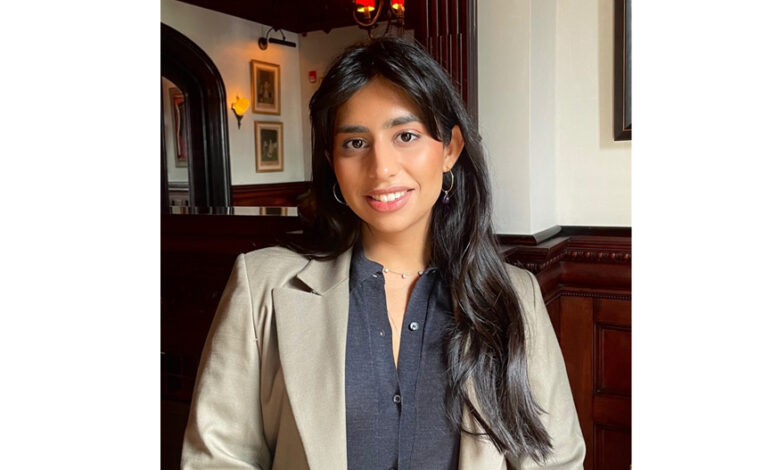
Before she ever signed a term sheet or joined an investment committee, Amira Chanana was quietly assembling a set of experiences that now make her a distinctive kind of angel investor and ecosystem builder. Her trajectory did not begin in a venture firm; it took shape through education, operating roles, community engagement, and a steady gravitation toward founders
Amira’s academic roots are in New York, where she studied at Barnard College and Columbia. Being in that environment matters. New York is one of the few places where finance, technology, art, and social impact co-exist and constantly bump into each other. For a young professional curious about how ideas turn into institutions, it is a powerful classroom outside the lecture halls. In that setting, Amira was exposed not only to the theoretical side of economics and policy but also to the energy of people experimenting with new products, platforms, and communities around them.


Rather than heading straight into a classic graduate program or a purely corporate track, she moved into roles within technology and growth-stage businesses. These weren’t abstract positions. They involved the messy work of helping companies figure out partnerships, business development, and operations while still early enough that every decision felt consequential. In practice, that meant sitting close to revenue, customers, and product teams, seeing how strategies lived or died in the real world.
Operating at that stage teaches lessons no spreadsheet can fully capture. Amira saw what happens when a team makes its first key hires, how culture shifts as headcount grows, and how fragile early traction can be if it isn’t backed by real understanding of the customer. She watched leaders wrestle with trade-offs: do you prioritize product polish or speed, expand into a new market or deepen the one you have, chase a large enterprise client or build steadily from smaller accounts? That vantage point is now embedded in how she thinks about early-stage businesses.
Her journey into angel investing and ecosystem work was gradual rather than a sharp pivot. Amira describes being ‘brought into the room’ before she ever wrote her own cheques—asked for her opinion on founders, invited to contribute to diligence processes, and included in conversations about which companies might define a sector’s next chapter. Over time, she became a bridge between operators and investors, able to translate the language of teams building products into the risk-and-return frameworks of people allocating capital.
This bridging function is one reason she fits so naturally inside communities like Alma Angels, where she is both an investor and a leader. Alma is a network founded to direct capital toward women-founded, high-growth businesses, and it gathers people from many backgrounds: operators, executives, former founders, and career investors. Amira’s early-career mix positions her squarely in the middle of that Venn diagram. She understands the pressure founders are under because she has lived some version of it. She also understands what angel investors worry about: information asymmetry, alignment, the pace of deployment.
What makes her path especially relevant today is that it reflects a new archetype of investor. Instead of starting as an analyst in a fund and climbing a ladder, she accumulated context across multiple environments and then formalized her role in capital allocation. When NoBa Capital announced that she was joining as an Associate, the firm highlighted not just her analytical skills but her “heart, integrity, and deep commitment to the ecosystem.” That language is telling. The expectation is not just that she will source and evaluate deals, but that she will help build a community around the portfolio and contribute to the future-of-work thesis NoBa pursues.
Another often-overlooked influence on her professional foundation is her family’s philanthropic work. Through the Chanana Welfare Foundation (CWF), Amira has been involved in initiatives that include building and maintaining schools in villages near Roorkee in India. CWF describes her as an advisor and a driving force in the organization, and she has documented visits where she photographed children and communities benefitting from educational infrastructure the foundation supports. That experience of seeing how investment—in this case social and philanthropic—changes life trajectories informs the way she thinks about capital in the for-profit world as well.
The connective tissue across these early chapters is a consistent curiosity about how people’s environments can be improved when resources, ideas, and institution-building come together. In New York, that meant watching tech and finance overlap. In operating roles, it meant helping products find markets and markets find products. In philanthropy, it meant seeing how bricks, books, and basic infrastructure can open doors for children who might otherwise be left behind.
All of this is why, when founders meet Amira today, they are not just talking to someone who “works in venture.” They are speaking with someone whose lens was shaped by classrooms and communities, by early mornings in scaling startups, by on-the-ground visits to schools, and by thousands of small conversations in ecosystems from New York to London. For aspiring angels and ecosystem builders, her path offers a concrete template: immerse yourself where products are being built, stay close to communities doing meaningful work, and let investing emerge from that foundation rather than treating it as an abstract status to attain.
In that sense, Amira’s early career is not just a prelude to her investing; it is the source code. The way she evaluates founders, the way she designs communities like Alma’s Breakfast Club, and the way she shows up publicly all trace back to those formative years learning, building, and observing in multiple worlds at once.