
By Lakshmi Kanth Moganti
Research Scholar, Department of Environmental Science and Engineering, SRM University-AP


Dr. Deblina Dutta
Assistant Professor,Department of Environmental Science and Engineering, SRM University-AP
Every smartphone, computer, television and electronic device that reaches the end of its useful life leaves behind more than just waste. Inside discarded electronics are copper, aluminium, silver, gold and other valuable and strategically important materials. The challenge is no longer simply how to dispose of electronic waste, but how to recover these resources efficiently while reducing the environmental footprint of recycling.
As India expands its digital economy, this question is becoming increasingly important. Under India’s Extended Producer Responsibility framework, 28.75 lakh tonnes of e-waste had been recycled through 386 registered recyclers as of March 2026, according to the Government of India. At the same time, India is strengthening its critical-mineral recycling ecosystem, with 58 companies made eligible in 2026 under a ₹1,500-crore incentive scheme covering recycling from e-waste, batteries and industrial scrap.
The scale of the challenge
Electronic waste is unusually difficult to recycle because it is a mixture of plastics, ceramics, glass and numerous metals present in highly different concentrations. Printed circuit boards, for example, may contain copper, aluminium, zinc, nickel, tin, silver and gold alongside complex non-metallic materials.
Conventional recycling can involve mechanical processing, high-temperature treatment or strong mineral acids. These approaches can recover valuable metals, but they may also require substantial energy, generate secondary wastes or involve corrosive chemicals.
This is where smart recycling could change the way e-waste is managed.
Can AI make recycling smarter?
Artificial intelligence is increasingly being explored as a tool for identifying, sorting and managing complex waste streams. Computer vision and machine-learning systems can potentially distinguish different electronic components, identify material categories and support automated sorting before chemical processing begins.
This matters because better sorting can mean better recycling.
Instead of sending a heterogeneous mixture of electronic waste into a single treatment process, intelligent sorting could divide it into relatively well-defined fractions. A copper-rich printed circuit board fraction, for example, could then receive a different treatment from a battery-containing or rare-metal-rich fraction.
India’s 2026 discussions on e-waste governance are already emphasizing data-driven monitoring, digital compliance systems, circularity and improved coordination between producers and recyclers.
The future recycling facility may therefore look very different from today’s conventional waste-processing plant: sensors and AI at the front end, followed by targeted physical and chemical recovery.
Where do green solvents fit?
Once valuable fractions have been separated, the next challenge is recovering the metals.
One emerging approach is the use of deep eutectic solvents (DESs). These liquids are generally prepared by combining two or more components, often a hydrogen-bond acceptor and hydrogen-bond donor, in appropriate proportions. Their properties can be tuned by changing their composition.
For metal recovery, this tunability is particularly attractive.
Rather than using the same chemical treatment for every waste stream, researchers are investigating DES formulations that can interact with particular metals and facilitate their dissolution and subsequent recovery.
Recent research has demonstrated DES-based approaches for recovering metals from electronic waste, while newer studies are moving toward task-specific solvents, closed-loop solvent regeneration and integration with electrochemical recovery.
An interesting example comes from IIT Madras, where researchers developed a DES based on thymol and capric acid to dissolve copper from e-waste. The recovered copper was subsequently used to produce copper nanoparticles, demonstrating how waste materials can potentially be converted into higher-value products rather than simply being discarded.
When AI meets green chemistry
The most interesting possibility may come from combining these technologies.
Imagine an e-waste recycling facility in which AI first identifies the composition of incoming electronic waste. The system then determines which fraction contains the highest concentration of a particular target metal. A suitable solvent system could subsequently be selected or optimized for that material.
The conceptual pathway would be:
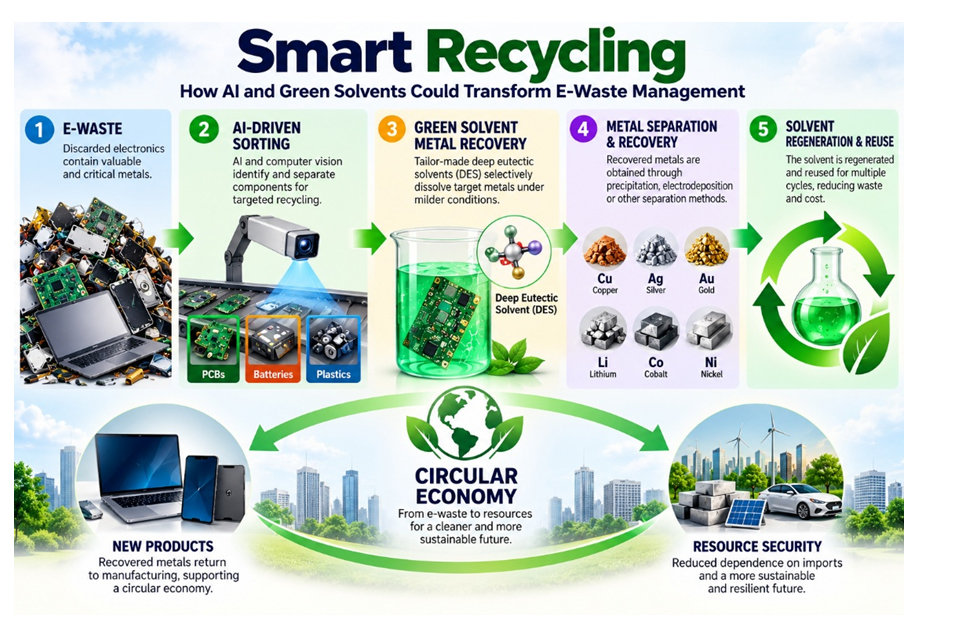
Such an approach could reduce unnecessary chemical consumption and improve resource efficiency.
In the longer term, machine-learning models could potentially be trained using experimental data linking DES composition, temperature, viscosity, metal concentration, leaching time and extraction efficiency. This could help researchers screen large numbers of possible solvent formulations before testing them experimentally.
But is a “green” solvent automatically sustainable?
This is where caution is necessary.
A solvent should not be considered sustainable simply because it has low volatility or is derived from relatively benign components. The entire life cycle needs to be considered.
How much energy is required to prepare the solvent?
How many times can it be reused?
Does its composition change after repeated metal recovery?
What happens when the solvent eventually reaches the end of its useful life?
How much water and energy are consumed during metal separation?
Recent DES research identifies high viscosity, mass-transfer limitations, incomplete recyclability, long-term degradation and limited industrial-scale demonstrations among the major challenges that still need to be addressed.
Therefore, the real goal should not simply be high metal extraction. It should be high recovery with low waste, low energy consumption, solvent reuse and measurable environmental benefits.
Closing the circular loop
This is where the concept of the circular economy becomes important.
The ideal e-waste process would not end after recovering copper, silver or other metals. Recovered materials should return to manufacturing, while the solvent is regenerated and reused and the remaining materials are also considered for further valorization.
India is increasingly framing critical-mineral recycling in precisely this way. In September 2026, the Ministry of Mines described e-waste as a source of valuable secondary resources and linked responsible recycling with resource efficiency and a circular economy.
The objective is therefore shifting from “How do we manage e-waste?” to “How do we keep the materials contained in e-waste circulating?”
The road ahead
AI and deep eutectic solvents are not a complete solution to the e-waste problem. Both technologies still face challenges involving cost, scale-up, reliability, energy use and environmental validation.
But together they point toward a different model of recycling: one that is smarter at the front end, more selective during material recovery and more circular at the back end.
The future of e-waste management may therefore not be a larger landfill or simply a bigger recycling plant. It could be an intelligent resource-recovery system in which discarded electronics are identified, separated, chemically processed, regenerated and returned to the manufacturing cycle.
In that future, electronic waste would no longer be viewed merely as the end of a product’s life. It could become the beginning of the next material cycle.